Author Archives: blueshirtkhakipants

Rational Expressions – V is for Victory

145 VIsForVictory

Rational Expressions – Math in Verse

144 MathInVerse

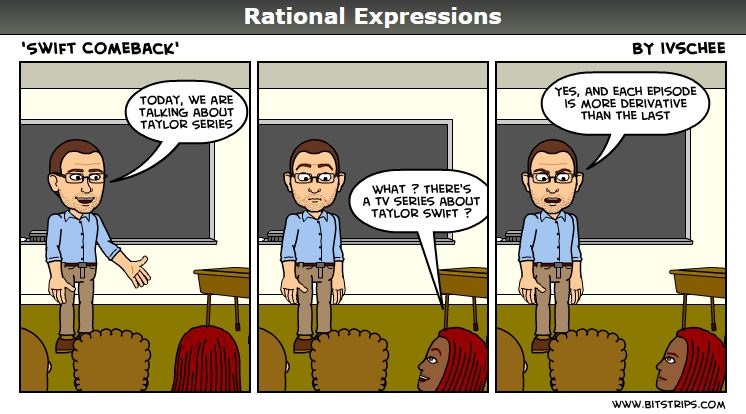
Rational Expressions – Swift Comeback

143 SwiftComeback

Rational Expressions – A La Mode

142 ALaMode

Rational Expressions – Parent Function

141 ParentFunction

Rational Expressions – Auntie Derivative

140 AuntieDerivative

Flipped Classroom – Students Teaching Students

I am a firm believer in the idea that the “Chapter Review” or “Unit Review” is the student’s responsibility. After all, “review” means “to see again” and I’ve already shown it to them once.

So here’s what I do. I give all students access to the Chapter Review at the beginning of the chapter. As the chapter progresses, I point out which questions they should be able to to at this point.

When the chapter ends, my formal instructional obligation is complete. Now the review is their responsibility, as a class. And that is exactly how I present it to them.

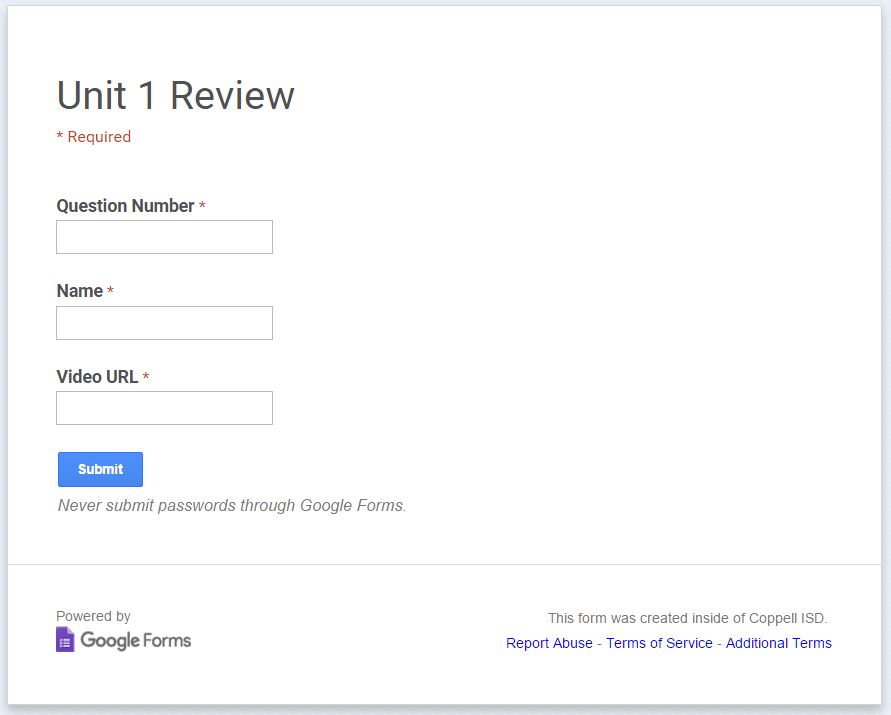
In my class, I give two days for review. On the first day, students are required to make a video of the solutions to any three questions on the review. (There are usually 8-10 questions total on the review.) I advise them to use EduCreations to create their videos, or to post them on YouTube, since these two options have URLs associated with their videos. Once they have recorded their videos, students fill out a Google Form giving me their name, question number, and the URL to their video. They are to do this three times, once for every problem they solved.
Review1

After the first day, I compile a list of all of the questions that have been answered in video format, and sort them by question number. On the second day, I present them with a TinyURL that links to the entire list, and I tell them that they can watch any video to help them understand how to solve the problem, and they can watch as many different videos as they need to in order to understand it completely.

Review2

Why do I do this? Honestly, while I have complete confidence in my ability to explain the necessary concepts, I feel that, more often than not, students learn better from each other, because they speak the same language, even when they are talking about complicated math problems. I was worried at first that I would hear words like “stuff” and “things” and “this part over here.” Instead, I noticed that students like to use the right terminology as much as possible. In fact, they use proper terminology more than I do!

When I first introduced this method of review, the students were understandably nervous. Most of them, understandably, don’t like the sound of their own voice when they hear it in a recording. Others were unsure that they explained it properly, or even got the right answer. (I post all videos, by the way, because I believe it’s still beneficial to learn from others when they make mistakes.)

As the year went on, students got more comfortable with this idea, and even got creative with it. Sometimes they would alter their voice, speak with an accent, and find other ways to make their videos a little bit silly, but still informative.

This method or reviewing for tests has proven to be very successful over the past few years, to the point where I actually started including videos of former students for my current students to watch. (After all, it’s better to have too many resources from which to study than too few, right?) Students are now taking ownership of their review process, and they are no longer relying on me to re-teach them concepts before tests.

The results? Two years ago, 90% of my students passed the IB Math exams. This past year, 93% of my students passed the IB Math exams. To clarify things, IB students are scored on a range from 1 to 7, with 4 and higher considered to be a passing score. Here is a closer look at how these scores were allocated:

Review3

My job in the classroom on review days has shifted. Now I provide formative assessment on their process of studying from others. As I watch, they listen intently. They take notes. They rewind videos if they don’t quite understand part of the process. And when they just don’t understand, they move on to someone else’s explanation. This is a combination of high-level communication skills, collaboration skills, organization skills, and problem solving skills, all of which will prepare them for college and for their career.

Rational Expressions – Don’t Cut Corners

139 DontCutCorners

Rational Expressions – Making Waves

138 MakingWaves

Flipped Classroom – Teaching the World

Up until this point, I have been creating my videos, and posting them to (i) the “Coppell IB Math” Google Site, and (ii) the iTunes U courses I created for Math Higher Level 2, Math Standard Level 2, and Math Studies. I’ve also been posting the videos on YouTube, just to give my students different options for locating the videos. And I was happy as long as my students were able to access the videos.

Little did I know that, over time, it wasn’t just my students that were subscribing to my iTunes U courses. While I have only taught about 300 Higher Level 2 and Standard Level 2 students,  I have noticed that over 1700 people have subscribed to my HL2/SL2 iTunes U course! Similarly, I have taught a total of 10 Math Studies students, but more than 800 students have subscribed to my Math Studies iTunes U course!

Then I started looking at my YouTube videos. By the way, YouTube allows you to see who has been watching your videos, and can give you these statistics in as many ways as you can imagine. Not knowing this until recently, I decided to investigate. First of all I have 198 subscribers, but I only recognize 17 of them as students I have taught in my class. Then I went to see how many views … over 40,000 views!! This raised some questions, like: Which video do they watch the most? Where are the viewers from?

Apparently, my 5 most watched videos, as of August 30, 2015, are:

  1. 10,515 views – Derivatives of arcsin(x), arccos(x), arctan(x)
  2.   8,539 views – Fermat’s Little Theorem
  3.   5,064 views – Linear Congruences
  4.   1,906 views – The Chinese Remainder Theorem
  5.      849 views – Linear Diophantine Equations

And the viewers come from countries all over the world. Here are the top 10:

  1. 16,206 views – United States
  2.   3,462 views – India
  3.   2,926 views – United Kingdom
  4.   2,846 views – Canada
  5.   1,452 views – Philippines
  6.      876 views – Australia
  7.      778 views – Sweden
  8.      680 views – South Africa
  9.      509 views – Malaysia
  10.      481 views – Norway

For a complete chart of all countries with more than 200 views, click this link: YouTubeStats

I never dreamed that when I would start the Flipped Classroom that my silly little videos would help teach students across the world. And the YouTube watchers (again, not my students) are also very generous with their compliments too!

  • Thank you!  I am teaching myself number theory with the goal of making it part of a high school discrete math course that I’d like to teach.  This is most helpful and explained quite well.  I will definitely check out your other material.” – J.M.
  • “I will have a paper 3 IB exam tomorrow, thank you so much for your videos! They are all really helpful! :)” – T.V.
  • “Thank you Ian! Finally i got this!” – L.L.
  • “wow.. you are saving my life..your explanation is so clear and easy to follow..thank you very much..” – K.K.
  • “Hey Ian, I really appreciate this video. You do a great job with these videos. In 10 minutes you clarified something I’ve been wrestling for a week since my “professor” explained it in class.  Molte Grazie!” – A.G.

One YouTube viewer from Lapu-Lapu City in the Philippines liked my video on Fermat’s Little Theorem and asked if I would explain Wilson’s Theorem. I told her that it wasn’t part of my curriculum, but afterward, I became curious as to what Wilson’s Theorem was. So I researched it, found a proof that I could follow, and made a video for her. It can be found here: https://www.youtube.com/watch?v=Gk2yjoICL68

She liked the video so much that she sent me several messages:
  • “thank you very much for the effort sir.. and i learn much from your video!!”
  • “you really Help me in my Studies..thank you again”
  • “a million thanks to you sir.. thank’s God that theirs still a person like you sir..whose willing to help whose in need..i cant explain how glad i am.. that theirs a person who is willing to help me..”

So I encourage all of you who have started flipping, or are skeptical about flipping: There are so many benefits to flipping that occur in your own classroom, with your own students. But you never know who in the world (literally) you will be teaching by publicly sharing your knowledge with others.

1ACross

For cruciverbalists...A Good Place to Start..

Megan Fiona

Read All About My Journey and Experiences Here!

Continuous Everywhere but Differentiable Nowhere

I have no idea why I picked this blog name, but there's no turning back now

emergent math

Lessons, Commentary, Coaching, and all things mathematics.

Mathematics for Students

Learning Mathematics - Resources for Students

techieMusings

Discovering & sharing innovative ways to leverage technology to deepen relationships, build confidence, & create a safe learning environment where every student feels empowered to share their voice

janet's life

growing up and journeying forward

dy/dan

MY FLIPPED CLASSROOM