Category Archives: Flipped Classroom
My experience with my new flipped math classes!
Flipped Classroom – Flipping On-Level Algebra 2
They said it couldn’t be done. In fact I was told by some of my closest (non-flipping) colleagues, “Flipped classroom doesn’t work with on-level students.” Period. Maybe I’m stubborn, but I took that more as a dare than a warning.
So yes, I plan to start using the flipped approach with my on-level Algebra 2 students. While they are just as capable as my IB Math students, I realize that their attitude towards learning math independently may vary slightly. So I have to approach this differently. First, I have to give them the motivation to watch the videos at home. And second, I have to give them some accountability that lets me know that they are actually doing what I asked them to do at home. I have to admit I’ve been listening to Jon Bergmann’s podcast for inspiration, and it has been extremely helpful.
The motivation is simple: most of these kids are naturally social. So the classroom activities that follow the basic lessons must be of a very social nature. That way, if students don’t watch the videos at home, they must watch them during class, delaying their ability to be social during the activity.
The accountability is equally simple: a set of fill-in-the-blank notes that matches the content of the video exactly. I give this to the students as they leave class, and they bring it back the next day. For absent (or absent-minded) students, an online copy of the same blank notes is available.
Here’s how I plan to unroll the new approach:
Step 1: Teach the lesson using a pre-made Powerpoint – the kind I use in my videos – while students take notes. This gets students familiar with how the lessons will look once they are watching them at home – the animations, the transitions, the fonts, the explanations. I will do this for a week so that the pattern is set.
Step 2: Watch the videos during class, while students fill in their notes. Students realize that watching these videos is not like watching a movie. They have to pay attention and follow the examples. They have to write things down, and they have to understand what they are writing. While they watch the video, I walk around and encourage them as they take notes.
During this same time frame, we start some of the more social learning activities for each lesson, at different levels depending on how comfortable they are with the content. I also hold small group tutoring sessions for those that need further assistance in understanding. But we soon realize that we don’t have enough time to do it all.
After about a week, we have a discussion about whether they prefer to sit and take notes during class, or whether they prefer we spend the time doing activities that could actually be completed during class. (Which do you think they will choose?) At this point, I ask them if they would be willing to fill in the notes at home so that we could have more time in class. This would require a majority of participation in order to work, but that’s where peer pressure – the good kind – would be a motivating factor. Since they may not remember where to find the videos at first, I put a QR code and a tinyurl address at the top of the notes page. I tell them that they must watch the video and fill in their notes during the evening in order to participate, and I stick to it. Classroom laptops would be available for those who forget or choose not to watch. Those who did watch the video can then participate in the activities. They can pick their comfort level, they can work with each other, or they can get more guidance from me.
So that’s the plan. It may work, or I may get egg on my face. Either way, I’m trying. And if I do fail, that just means that this plan didn’t work, but I won’t give up. I believe in this so much, and how it builds student-teacher relationships, and how it allows me to scaffold instruction to meet individual needs. I really hope this works, and if it doesn’t, I’ll just reflect on it, fix what I can, and try again.
Flipped Classroom – Students Teaching Students
I am a firm believer in the idea that the “Chapter Review” or “Unit Review” is the student’s responsibility. After all, “review” means “to see again” and I’ve already shown it to them once.
So here’s what I do. I give all students access to the Chapter Review at the beginning of the chapter. As the chapter progresses, I point out which questions they should be able to to at this point.
When the chapter ends, my formal instructional obligation is complete. Now the review is their responsibility, as a class. And that is exactly how I present it to them.
In my class, I give two days for review. On the first day, students are required to make a video of the solutions to any three questions on the review. (There are usually 8-10 questions total on the review.) I advise them to use EduCreations to create their videos, or to post them on YouTube, since these two options have URLs associated with their videos. Once they have recorded their videos, students fill out a Google Form giving me their name, question number, and the URL to their video. They are to do this three times, once for every problem they solved.
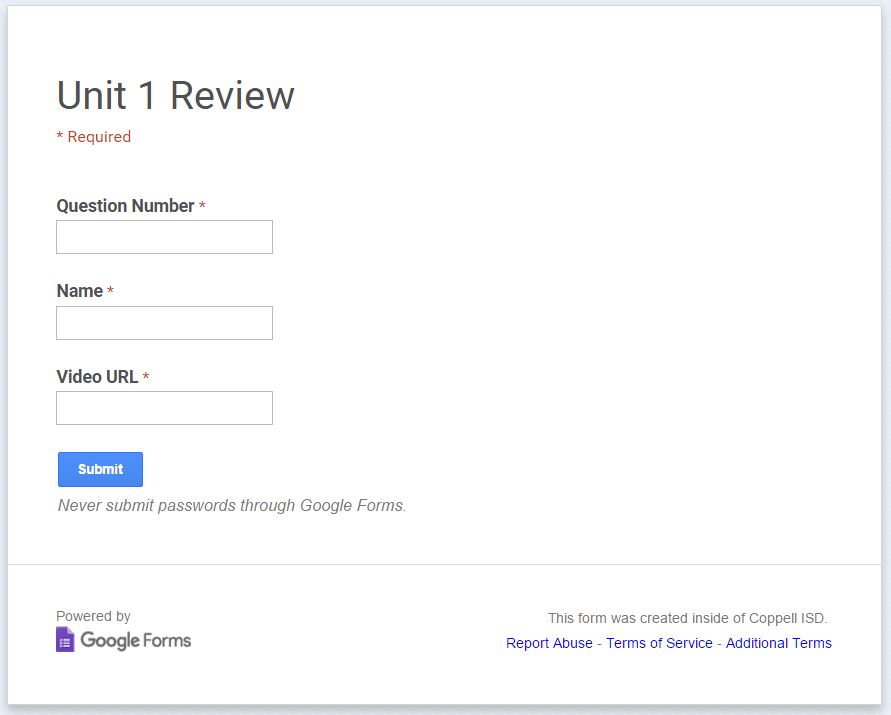
After the first day, I compile a list of all of the questions that have been answered in video format, and sort them by question number. On the second day, I present them with a TinyURL that links to the entire list, and I tell them that they can watch any video to help them understand how to solve the problem, and they can watch as many different videos as they need to in order to understand it completely.

Why do I do this? Honestly, while I have complete confidence in my ability to explain the necessary concepts, I feel that, more often than not, students learn better from each other, because they speak the same language, even when they are talking about complicated math problems. I was worried at first that I would hear words like “stuff” and “things” and “this part over here.” Instead, I noticed that students like to use the right terminology as much as possible. In fact, they use proper terminology more than I do!
When I first introduced this method of review, the students were understandably nervous. Most of them, understandably, don’t like the sound of their own voice when they hear it in a recording. Others were unsure that they explained it properly, or even got the right answer. (I post all videos, by the way, because I believe it’s still beneficial to learn from others when they make mistakes.)
As the year went on, students got more comfortable with this idea, and even got creative with it. Sometimes they would alter their voice, speak with an accent, and find other ways to make their videos a little bit silly, but still informative.
This method or reviewing for tests has proven to be very successful over the past few years, to the point where I actually started including videos of former students for my current students to watch. (After all, it’s better to have too many resources from which to study than too few, right?) Students are now taking ownership of their review process, and they are no longer relying on me to re-teach them concepts before tests.
The results? Two years ago, 90% of my students passed the IB Math exams. This past year, 93% of my students passed the IB Math exams. To clarify things, IB students are scored on a range from 1 to 7, with 4 and higher considered to be a passing score. Here is a closer look at how these scores were allocated:

My job in the classroom on review days has shifted. Now I provide formative assessment on their process of studying from others. As I watch, they listen intently. They take notes. They rewind videos if they don’t quite understand part of the process. And when they just don’t understand, they move on to someone else’s explanation. This is a combination of high-level communication skills, collaboration skills, organization skills, and problem solving skills, all of which will prepare them for college and for their career.
Flipped Classroom – Teaching the World
Up until this point, I have been creating my videos, and posting them to (i) the “Coppell IB Math” Google Site, and (ii) the iTunes U courses I created for Math Higher Level 2, Math Standard Level 2, and Math Studies. I’ve also been posting the videos on YouTube, just to give my students different options for locating the videos. And I was happy as long as my students were able to access the videos.
Little did I know that, over time, it wasn’t just my students that were subscribing to my iTunes U courses. While I have only taught about 300 Higher Level 2 and Standard Level 2 students, I have noticed that over 1700 people have subscribed to my HL2/SL2 iTunes U course! Similarly, I have taught a total of 10 Math Studies students, but more than 800 students have subscribed to my Math Studies iTunes U course!
Then I started looking at my YouTube videos. By the way, YouTube allows you to see who has been watching your videos, and can give you these statistics in as many ways as you can imagine. Not knowing this until recently, I decided to investigate. First of all I have 198 subscribers, but I only recognize 17 of them as students I have taught in my class. Then I went to see how many views … over 40,000 views!! This raised some questions, like: Which video do they watch the most? Where are the viewers from?
Apparently, my 5 most watched videos, as of August 30, 2015, are:
- 10,515 views – Derivatives of arcsin(x), arccos(x), arctan(x)
- 8,539 views – Fermat’s Little Theorem
- 5,064 views – Linear Congruences
- 1,906 views – The Chinese Remainder Theorem
- 849 views – Linear Diophantine Equations
And the viewers come from countries all over the world. Here are the top 10:
- 16,206 views – United States
- 3,462 views – India
- 2,926 views – United Kingdom
- 2,846 views – Canada
- 1,452 views – Philippines
- 876 views – Australia
- 778 views – Sweden
- 680 views – South Africa
- 509 views – Malaysia
- 481 views – Norway
For a complete chart of all countries with more than 200 views, click this link: YouTubeStats
I never dreamed that when I would start the Flipped Classroom that my silly little videos would help teach students across the world. And the YouTube watchers (again, not my students) are also very generous with their compliments too!
- “Thank you! I am teaching myself number theory with the goal of making it part of a high school discrete math course that I’d like to teach. This is most helpful and explained quite well. I will definitely check out your other material.” – J.M.
- “I will have a paper 3 IB exam tomorrow, thank you so much for your videos! They are all really helpful! :)” – T.V.
- “Thank you Ian! Finally i got this!” – L.L.
- “wow.. you are saving my life..your explanation is so clear and easy to follow..thank you very much..” – K.K.
- “Hey Ian, I really appreciate this video. You do a great job with these videos. In 10 minutes you clarified something I’ve been wrestling for a week since my “professor” explained it in class. Molte Grazie!” – A.G.
One YouTube viewer from Lapu-Lapu City in the Philippines liked my video on Fermat’s Little Theorem and asked if I would explain Wilson’s Theorem. I told her that it wasn’t part of my curriculum, but afterward, I became curious as to what Wilson’s Theorem was. So I researched it, found a proof that I could follow, and made a video for her. It can be found here: https://www.youtube.com/watch?v=Gk2yjoICL68
Flipped Classroom – Year 4

I knew I wouldn’t regret Flipping my Classroom, and this year is going to prove it!
Let me give you some background: I teach IB Math in Coppell, and our program is still growing, which means I don’t yet teach full classes of 30 kids all taking the same level of IB Math. Instead, I have classes of 10 or 15, sometimes fewer, and it is challenging for school counselors to schedule all of those students, because they are also interested in Band or Athletics, or other extra-curricular activities that are usually only offered during specific periods of the day.
So students have limited choices as to when they can take the desired IB Math class, and equally limited choices as to when they can take their extra-curricular class. As a result, some students are left to choose one or the other. I don’t like this; I would hate for students to make such a choice. This goes against my belief in the purpose of high school, i.e., an opportunity to experience all avenues of education in order to wisely determine where they will go afterward.
And that’s the reason I’m glad I am flipping! Weeks ago, I told the counselor that I am willing to teach any IB math student during any of my available IB math periods. This means I have Higher Level students co-seated with Standard Level students, and I have Standard Level students co-seated with Math Studies students. For a non-flipping teacher, this would be a nightmare! But since I already have all of the videos and post-video quizzes made, my time during class is spent helping each student individually, and students are shown neither favoritism nor neglect.
I’m very excited about this year, because I think it speaks volumes as to what can be accomplished when flipping is implemented correctly. I don’t have to limit myself to one math course per period. With proper organization, I think this year is going to be an exciting challenge!
I still plan to keep those practices that have worked well for me in the past – the collaborative room layout, the Raw Hundo Club, an overview day at the beginning of each unit, a high-level discussion question at the beginning of class, and worksheets that lead to the punchline of a witty math joke. I still plan on using a flexible assessment, but I am thinking of making it mandatory at least twice per semester. This means that twice each semester, instead of taking the unit test, the student must create something of original design that demonstrates a high level of knowledge of the entire unit. The final product and the level of knowledge demonstrated is decided by the student based on a rubric that I provide in advance.
Again, I am very excited about this, my fourth year Flipping my Classroom. I will be sure to share details about my progress throughout the year.
Flipped Classroom – Blue Shirt Khaki Pants Day
A week ago, my students celebrated my birthday by coming to school dressed in blue shirts and khaki pants. It was truly a thrill to see all of them suddenly have an acute sense of fashion.
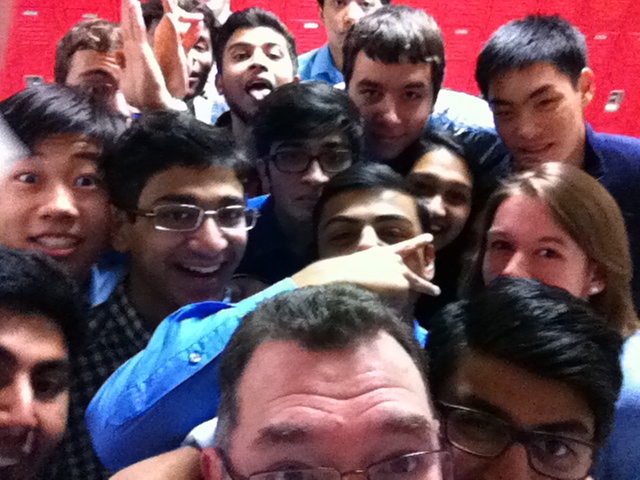


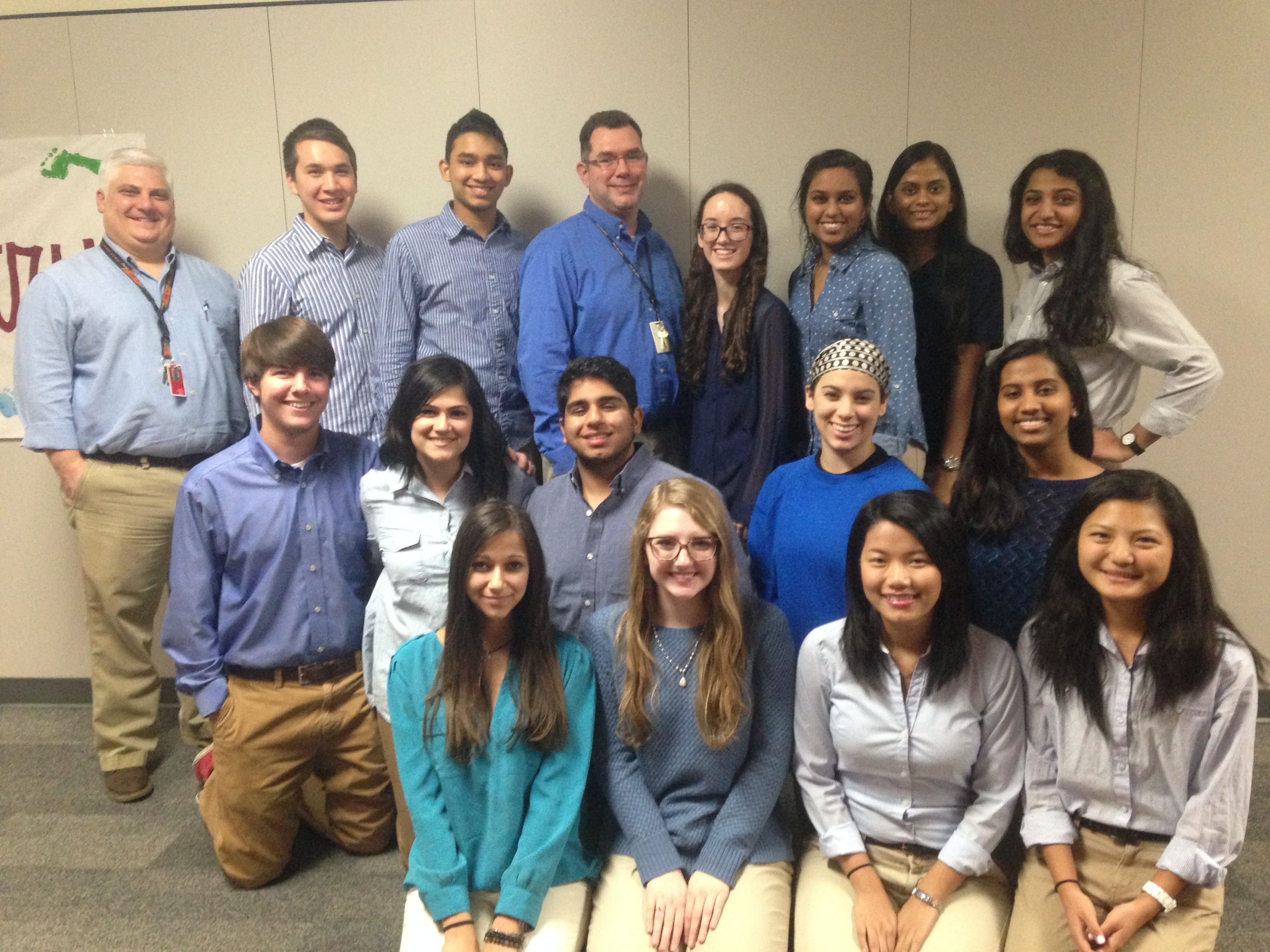


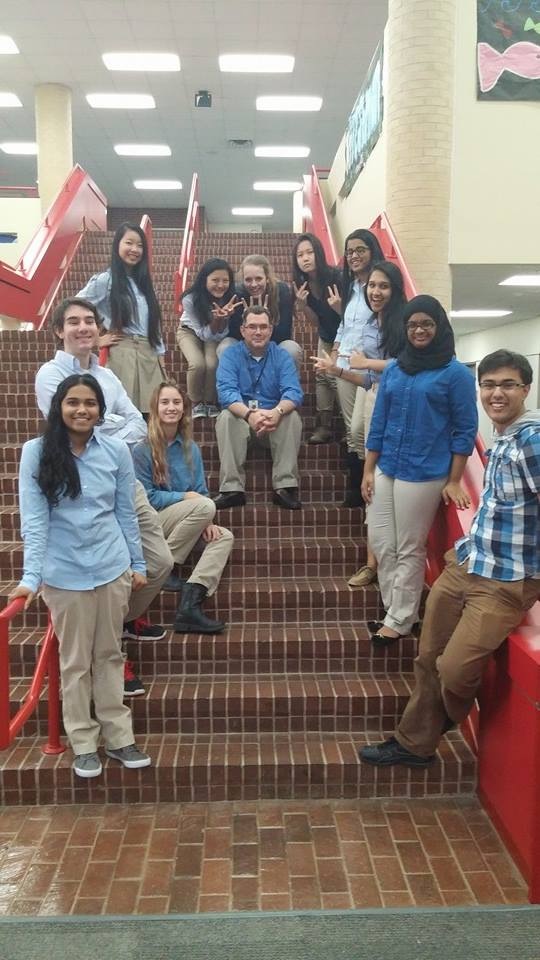
This year I also got a special treat, as three of my seniors from last year (from left: Sat H., Daniel C., and Suyash A.) came back from college to visit, and they too were following in the BSKP tradtion.
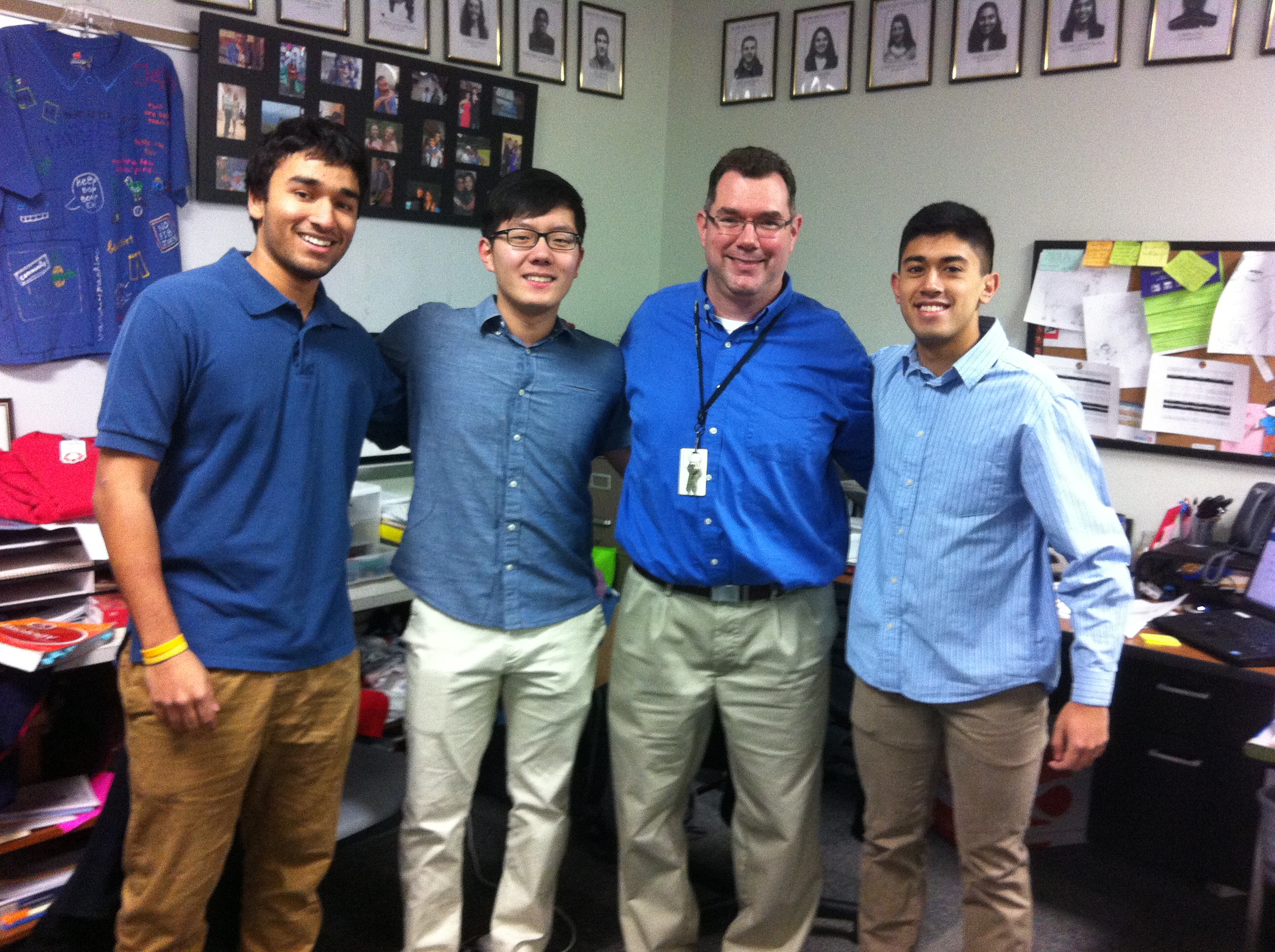
It was a very memorable birthday! Thank you so much to all of my students! You helped to make this a very special day!
Flipped Classroom – Incorporating Real World Events in the Mathematics Classroom
In an IB teacher meeting scheduled by English teacher, Michael Vergien, we decided to embark on an intercurricular discussion about the referendum in Scotland over the possibility of its separation from the United Kingdom. We all contributed ideas as to what could be discussed in each of our respective disciplines.
In math, Karie Kosh and I decided to put a “find-the-probability” spin on it. The question was asked, “If another referendum is held 5 years from now, what is the probability that the majority of Scots will vote for separation?”

On the first day, each small group chose one factor that would quantifiably have an impact on whether voters may want to separate. Each group then researched that factor as it pertained to Scotland’s government, economy, and people. As I walked around listening to the discussions, I was fascinated at the different approaches as to what was important, and how they could attach a numerical value to vague concepts like nationalism. There was a lot of good research done, and a lot of consideration to the demographics of the voters in five years, as it compared to the voters that had just voted in this year’s referendum.
On the second day, each group was asked to figure out what percentage of voters would vote for separation, based solely on the factor that they researched. Then, as a class, we ranked each factor from 1 to 7, with 7 being extremely important.
Here’s where the math came in. Using a formula that is similar to the formula for expected value, we multiplied each probability by the respective ranking, added it all up, and divided by the sum of the rankings.
This allowed us to find the approximate predicted percentage of “yes” voters five years from now. Admittedly, there was some guesswork, but in the end, I feel that the exercise of taking mathematical concepts and applying them to current world events proved invaluable.
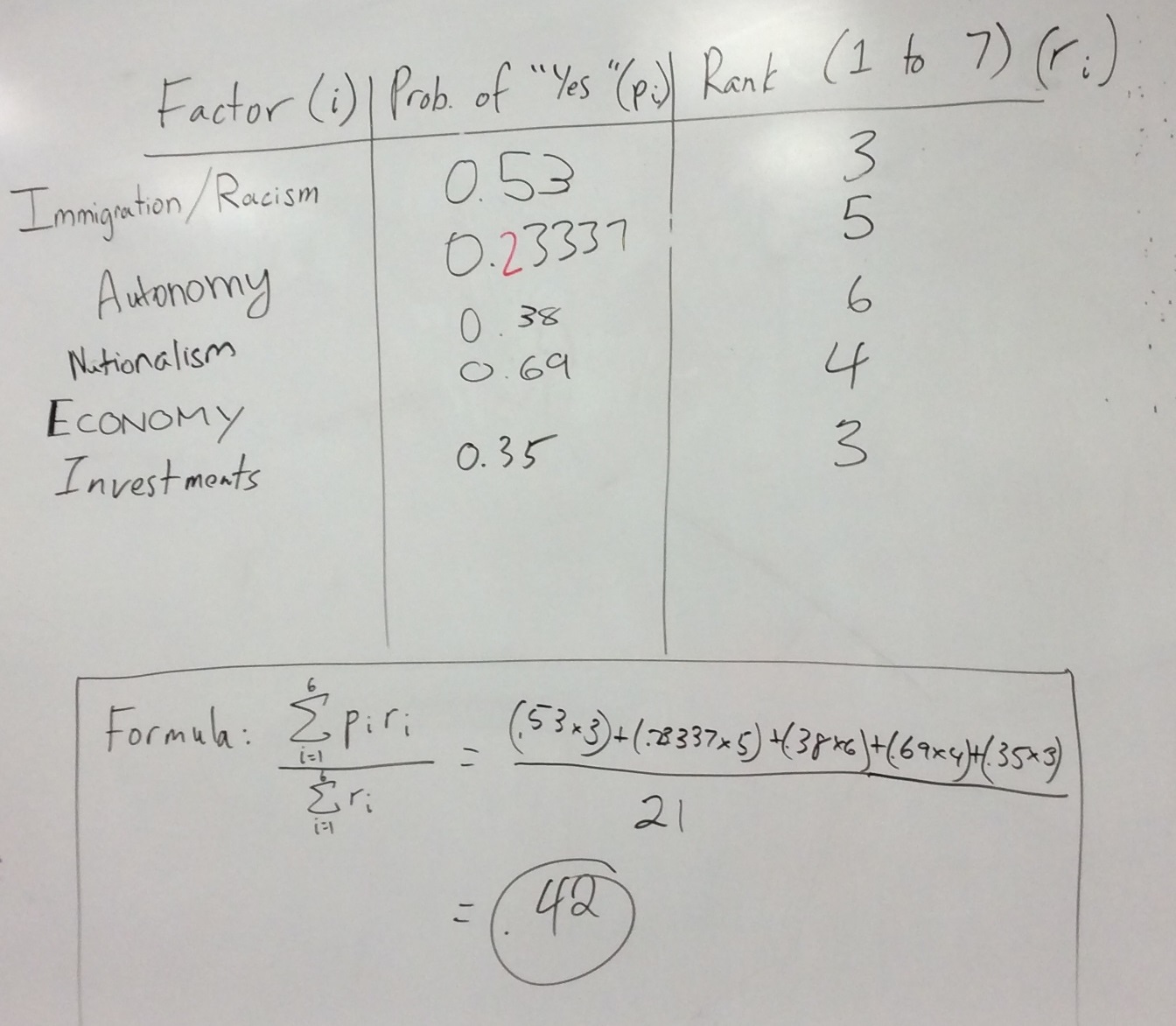

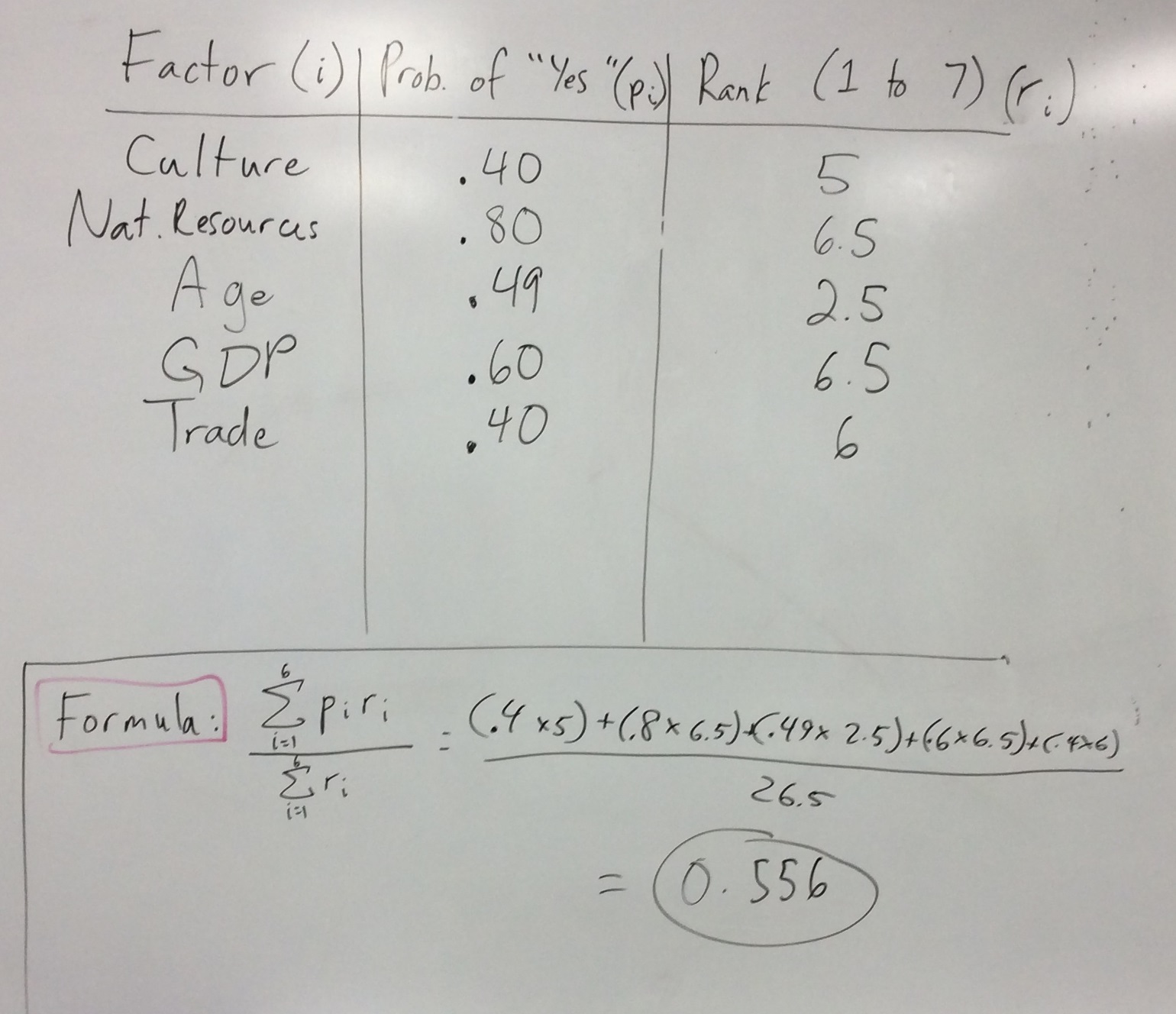
It’s always nice when teachers get the opportunity to plan out the entire year so that they know exactly what will happen on each day, but I now see the value in breaking away from the schedule to look at the real world and apply theoretical concepts to the reality around us. I have grown to embrace the unexpected – the problems with many right answers – and this experience now has me looking more closely at the most current world events to see how I can create a learning experience out of them.
Thank you to Michael Vergien for the idea, and to Karie Kosh, for brainstorming with me to make this an overwhelming success.
Flipped Classroom – Overview Day
For the first time this year, I employed my idea of an Overview Day. We are about to begin our first unit on Derivatives, so I wrote the words “Derivative” and “Differentiation” on the board with a circle around it. It was their job to research these terms, and add any important words, phrases, formulas, or pictures to the board. When they finished, we had a very nice summary of the entire chapter that THEY created! I went through and explained how each part was relevant to derivatives, and how they would be used. This way, when they see these words, phrases, etc., again, it will reinforce today’s discussion. Here are the results of their research:
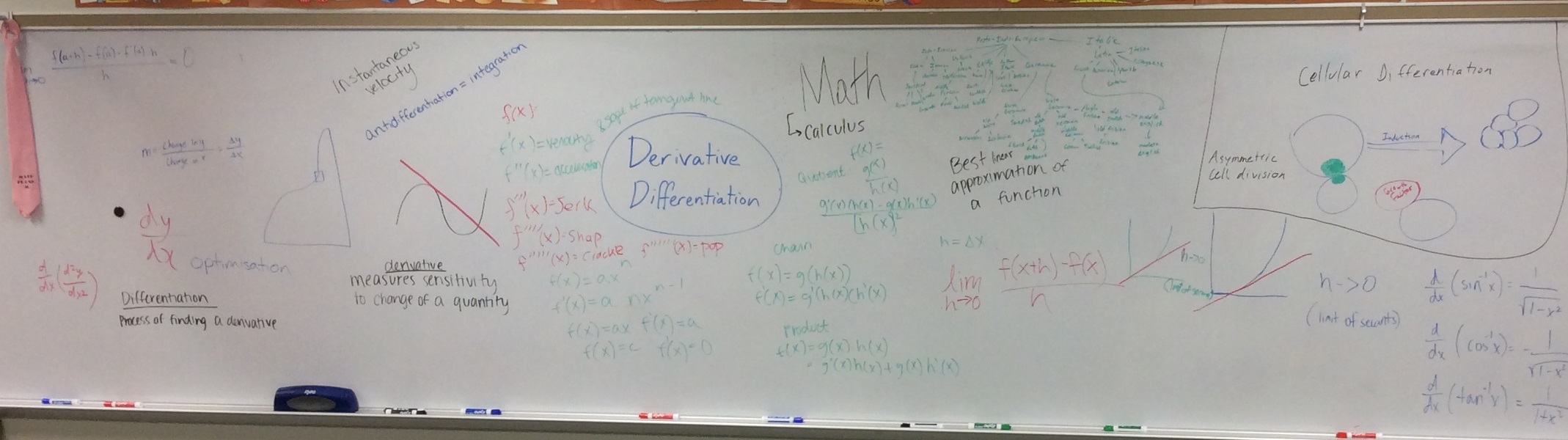
A lot of good and accurate work is shown here, even if the students don’t quite understand the meaning of it all. I really like one student’s cross-curricular humor in including a “cellular differentiation” diagram as well as the “derivatives” of Proto-Indo-European languages. And in case you’re wondering, yes, “snap, crackle and pop” are actually terms, albeit facetious ones, used by physicists in their discussions of derivatives.
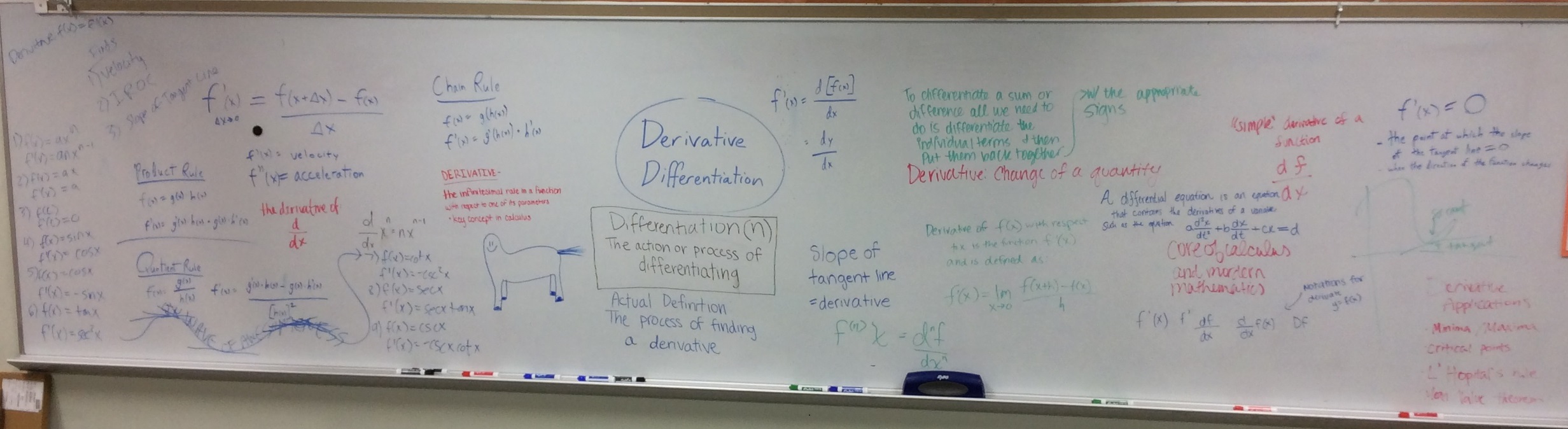
This is another group’s results. Lots of good research on this one as well. The discussion with this group was more interactive, which you can’t really see, but it’s worth mentioning. I really like the creature that looks like an earless horse.
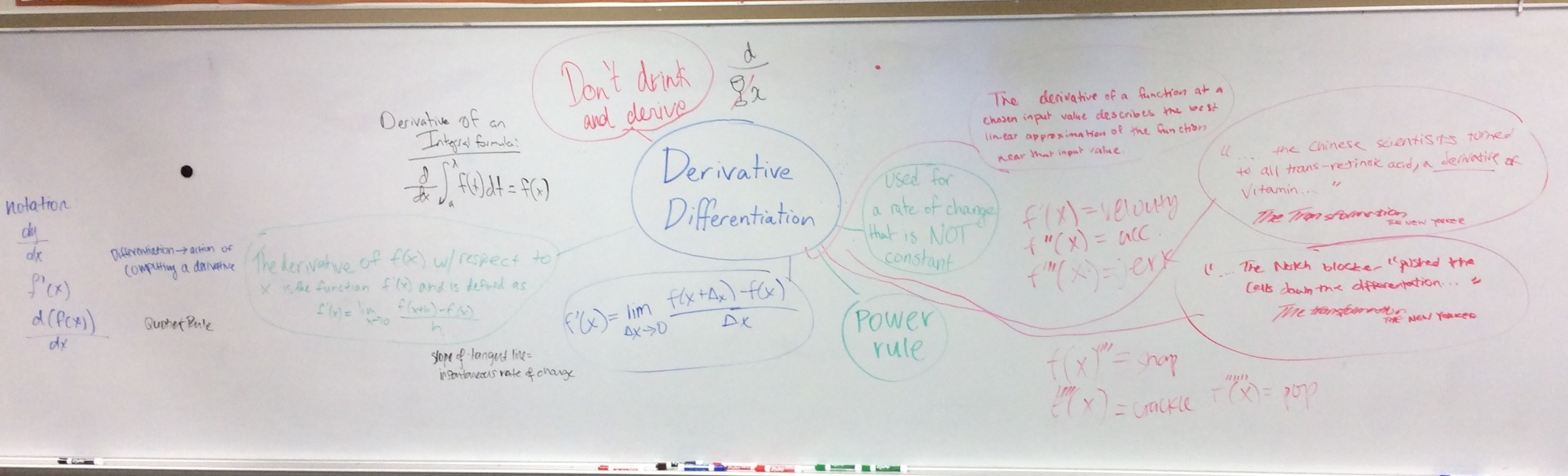
This class is my smallest class, which explains why there are fewer contributions. They still get the main idea though, and one student even added a joke, which I’ve seen before, but now it makes sense to him.
All in all, I would count today a success, and I will definitely be doing this again. Getting students to seek answers themselves instead of waiting for a lecture should be a life skill that we teach them anyway. I can’t wait to see how this impacts the level of understanding as we progress through the chapter!
Flipped Classroom – Back in My Day
It’s Sunday morning, and my younger son is awake and wants to watch his favorite cartoon. I’ve already recorded all of the episodes and can ask him which one he wants. I can then start playing it, and even skip through the first thirty seconds of commercials so that it starts at the beginning of that catchy theme song.
This method of watching TV is not unfamiliar to many of us, but we can all remember a time when we could only watch a TV show when it was on, during a designated time slot, on a specific channel, and hopefully with a functional “rabbit-ears” antenna. (Some of you can go back to an even earlier time, but I don’t want to extend this part of the analogy too far before I make my point.)
Before we were teachers, we were all students, and I’m sure we can all instantly create a “back when I was in school” story. Oh, the menial tasks we were required to do. And my mind naturally drifts to math class. We had to calculate square roots, copy notes from an overhead, solve systems of equations, find inverses of three-by-three matrices – all by hand. (Our calculators only had four functions and one memory slot.)
We can certainly tell our students these stories, but only to the point where they understand what we are saying, like a narrative from a historical figure. But we can’t expect these same students to fully appreciate the experience of carrying out these tasks. And why should we? We have calculators, websites, and tablet apps that take care of all of this for us.
So should we stop teaching these skills altogether? No. Should we only direct students to the appropriate sites and apps to carry out these tasks? No. The key is balance. While it’s important to be able to solve certain problems quickly, using a calculator or other device, it is also important to understand what that device is doing, and what the end result actually means in terms of the original problem.
Let’s start with simplifying radicals, only because that concept was brought up to me this week. I propose that the concept should be taught by hand at first, so that students understand why the original radical and its simplified form are actually equal. After some practice, we can show how to perform the same task with a calculator. The question many teachers ask is, when would they ever need to do this by hand after they know how to use a calculator? The answer – variables. You can always create an “unsimplified” radical with variables, in which case the calculator is practically useless, and the old skills must be used.
Variables appear in the real world more often than we think. Sometimes we don’t have all of the information, and we need to find a temporary solution that we hold onto until the required information becomes available. Sometimes we want to create a rule, or formula, that we can use over and over, with different sets of given information. They can appear in almost every type of problem, including the radicals, systems, and matrices I mentioned earlier.
So let’s balance the old and the new. Do things by hand for appreciation, and in preparation for situations where the calculator can’t help. But don’t abandon the calculator because it “does the work for us.”
Times and technology are changing, and we need to embrace those changes. And on the other side, we also need to help students understand how technology works so they can decide when it is or isn’t helpful. There are times when we can choose technology to get us to the answer faster, but sometimes we just have to go “old school.”
To get back to my original story: While I’ve been writing this, I’ve had to help my son by skipping through commercials, and getting him to different episodes of the same show, all by clicking a few buttons. But I can’t help but think of the day when I will take him to the movie theater for the first time, simply to appreciate the experience. None of the technology we have will allow us to simplify that situation. The movie will start at a certain time in a certain room. It will only play once, and we will not be able to pause or rewind or start over. The lines will be long, the popcorn will be chewy, and the soda will be flat. And we’ll have to sit through all of the previews before the movie actually begins – just like it was back in my day.
Flipped Classroom – Year 3
 This will be my third year using the Flipped Classroom model, and I finally feel like I’m getting into a groove. If new videos need to be made, it’s easily done – recording, editing, posting – all in a short amount of time. The in-class discussions are more natural, and the relationships are getting stronger quicker.
And the proof is in the proverbial pudding. The scores on the IB math tests were higher than ever! Almost a 90% pass rate overall! And throughout the year, I read incredible essays and explorations, and had many impromptu deep mathematical discussions with several students.
All of this makes me excited for this year. Just like last year, there are things I am going to keep, and things I am going to remove from my day-to-day activities.
THINGS I WON’T CHANGE
- Room Layout – This has been so successful, even moreso this year – the groupings, the seemingly absent teacher desk, the empty walls at the beginning. To make things better, my class sizes have gone down to a maximum of 21, so I can move some of my tables and chairs into the hall as workstations for those who need to get caught up on videos or other work.
- Raw Hundo Club – The kids still love this! Sure, it leads to a competitive environment, somewhat, a
 nd sure it goes against my philosophy that “perfection is not a reasonable goal,” but there’s just something about seeing their faces mounted on a wall that gives kids a sense of confidence.
- Overview Day – This was very successful, and I think it fits very well with our campus’s Understanding by Design pedagogy. It gives me a chance to talk about each unit in a very general sense so that students can see why we are studying it, and how it fits into the concepts they studied before and the ones they will study after. They can ask very broad questions and I can teach the concept by itself without getting into the mechanics at all.
- Recap at the Start of Class – This is a great opportunity to address questions that students had after watching the video from the night before, especially if a lot of them had the same questions. It creates immediate focus because everyone who watched the video now knows what everyone is talking about.
- iTunes U – There are so many websites on which to post videos, and many of them are more customizable than iTunes U, and more versatile. But then there are district and campus restrictions. Our campus decided that all content would be posted to a Blackboard site or an iTunes U, and those were the only two options. I have tried voicing my opinion, especially after spending three years creating a fantastic Google Site, but to no avail. And my stuff was copied to iTunes U last year, so at least I don’t have to start from scratch. Don’t get me wrong, I love iTunes U, especially after their most recent update. I was just hoping to give the students more options as far as watching the videos in a format that they liked. So I do have my videos posted on YouTube and CrazyForEducation, and I will continue to do so, but only as a secondary resource for students who can’t access iTunes U.
THINGS I WILL ADD
- Worksheets as Practice – I know last year I said no worksheets. But then later I posted that I had changed my mind, and worksheets as an end goal was meaningless, but if it led up to something, then it would be valuable. The point is that while everyone needs a minimum amount of practice in order for a concept or process to be internalized, some people need more than that. So worksheet will be viewed as ungraded practice that I will monitor, and when students feel they have had enough practice, I will offer them two or three questions at a higher level. If they master them, then they have finished for the day. If not, they can keep practicing until they want to try again.
 Flexible Assessment – I will have two test days. If students are ready on the first day, they can take the test as normal. If they are not ready, they can take the test on the retest day and receive a maximum of 90%, just like the retesters would get. Alternatively, as I know that some students are not good test takers, I will give them the opportunity to come up with an alternate assessment – a report, a project, etc. – and the rubric with which it will be graded, both of which will have to meet with my approval. I don’t foresee a lot of students exercising this option, since it is a lot more work, but I’d be curious to see the ideas they have.
My theme this year is not just “learner-centered,” but “learner-driven.” The students will lead and contribute to discussions, and they will take responsibility for their own learning. Even though I am there as a support when they need me, I will encourage them to use me less and less, so that their success is truly their own.


 blue shirt khaki pants
So I encourage all of you who have started flipping, or are skeptical about flipping: There are so many benefits to flipping that occur in your own classroom, with your own students. But you never know who in the world (literally) you will be teaching by publicly sharing your knowledge with others.